Parashat Bereishit 5787
Rabbi Shmuel Rabinowitz, Rabbi of the Western Wall and Holy Sites
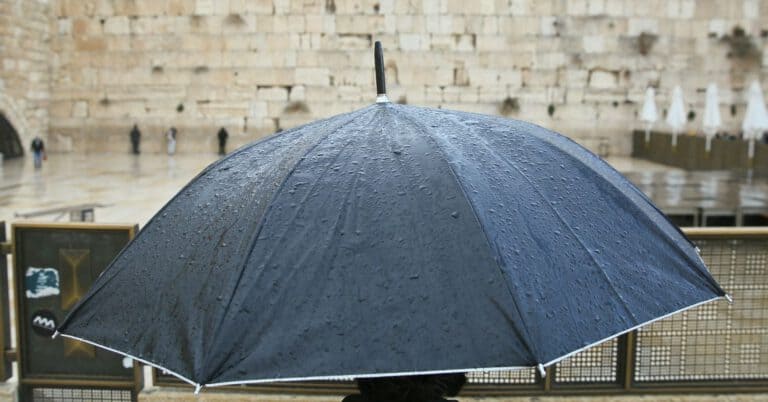
Few things accompany a person wherever they go and throughout every period of life as consistently as rain and water. We are so accustomed to them that we rarely stop to consider the wonder of their existence. Water surrounds us and is within us. It quenches our thirst, nourishes the earth, and makes life possible. Precisely because of this, it is fascinating to discover how central water is also to the Jewish world, and how much deeper our connection to it is than mere physical necessity.
Water is also the thread that connects the festival of Sukkot, which we recently concluded, with the first Torah portion, Parashat Bereishit, which is read on the first Shabbat after Sukkot.
Our Sages taught us (Mishnah Rosh Hashanah 1:2) that on Sukkot the world is judged concerning water, and that during the time of the Temple there was great rejoicing over the water libation on the altar. Even the aravah branches that we take on Hoshana Rabbah are connected by their very nature to water, since willow trees grow along riverbanks. And on Shemini Atzeret, the festival that concludes Sukkot, we already begin to pray for rain.
When we open the Book of Bereishit once again, there is a natural continuation of this theme. When the Torah tells us about the beginning of Creation, the first thing it reveals is a world covered in water:
“Now the earth was formless and void, and darkness was upon the face of the deep, and the spirit of God hovered over the face of the waters. And God said, ‘Let there be a firmament in the midst of the waters, and let it divide between water and water.’ And God made the firmament and divided between the waters that were beneath the firmament and the waters that were above the firmament, and it was so.”
The world we know was created through a separation between water and water, between heaven and earth, between the upper and lower realms. Yet precisely because separation is part of the order of Creation, there also exists a longing for connection. Our Sages describe this longing in a remarkable passage cited in the commentary of Rabbeinu Bachya ben Asher on the Torah:
“They said in the Midrash: The lower waters are called ‘weeping waters,’ because when the Holy One, blessed be He, divided the waters, He placed some above and some below. The lower waters began to weep, saying: ‘Woe to us that we were not worthy to ascend above and be close to our Creator.’ What did they do? They boldly broke through the depths and sought to rise, until the Holy One, blessed be He, rebuked them. He said to them: ‘Since you have done all this for My honor, the upper waters will not have permission to sing praise until they receive permission from you. Moreover, you will one day be brought upon the altar, in the form of salt and the water libation.’”
(Rabbeinu Bachya, Leviticus 2:13)
From this, we can understand something profound about the place of water in Judaism. Water is not merely a substance that sustains the body. It represents a movement of connection between heaven and earth, and of life flowing from the upper realms to the lower ones. When rain falls, the heavens and the earth that were separated at the beginning of Creation are, as it were, reunited, and the world enters a state of complete harmony.
This is why our Sages spoke so highly of the day of rain. As the Talmud teaches:
“Rabbi Abbahu said: The day of rain is greater than the day of the resurrection of the dead, for while the resurrection of the dead is only for the righteous, rain is for both the righteous and the wicked… Rav Yehudah said: The day of rain is as great as the day on which the Torah was given… Rava said: It is even greater than the day on which the Torah was given.”
(Taanit 7a)
The coming together of the waters creates a state of connection between rain and spirit. This is precisely the essence of the resurrection of the dead – the reuniting of soul and body that had been separated. And when the world reaches its spiritual potential, when spirit prevails over physical matter, there is no longer a place for separation.
The comparison between water and Torah is no coincidence. Rain and Torah may appear to be two completely different things, yet both bring life to the world. Rain causes the earth to flourish and makes human physical existence possible; Torah causes the human being to flourish and makes spiritual existence possible. Rain descends from above and reaches the entire earth, while Torah descends into the world and gives it meaning, direction, and purpose. As our Sages taught:
“For it was taught: ‘They traveled for three days in the wilderness but did not find water’ (Exodus 15:22). Those who expound Scripture said: ‘Water’ means nothing other than Torah, as it says: ‘Ho, everyone who thirsts, come for water’ (Isaiah 55:1). Since they traveled for three days without Torah, they became weary. The prophets among them arose and instituted that they should read [the Torah] on Shabbat and pause on Sunday, read on Monday and pause on Tuesday and Wednesday, and read on Thursday and pause on Friday, so that they would never go three days without Torah.”
(Bava Kamma 82a)
This understanding brings us back to the opening verses of the Torah. The world began with water, but the world was not meant to remain a world of water. The Holy One, blessed be He, created separation, established boundaries, brought forth dry land, and created a world in which human beings could live and act. Yet for the world to continue to exist, the waters must once again descend upon it.
The physical world can exist in a biological sense, but for it to contain human beings, meaning, morality, and purpose, it needs Torah. It is no coincidence that Torah is compared to water. Just as water descends from a higher place to a lower one, refreshes everything, and does not ask who is worthy to receive it (Taanit 7a), so too Torah can reach a person and bring life to their inner world.
After the Days of Awe, when we drew closer to the Creator, and after Sukkot, when we rejoiced and celebrated the beauty of our Jewish heritage, we return to Bereishit. We read once again how the world was created, and discover that from its very beginning, the Torah seeks to remind us of the secret of its continued existence: the world needs the abundance that comes to it from above.
Water sustains the body and the earth. Torah sustains the human being and the world. And a person can receive both, if only they recognize how to make their existence worthy of the purpose for which they were created.