Yom Kippur 5787
Rabbi Shmuel Rabinowitz, Rabbi of the Western Wall and Holy Sites
We stand at the threshold of the holiest day in the Jewish calendar – Yom Kippur. It is a day when the Jewish people open their hearts to purity, forgiveness, and repentance. Yet despite its greatness and spiritual intensity, Yom Kippur can sometimes be perceived as a frightening day. Ask people what they feel when they think about Yom Kippur, and many will speak of fear. The surprising truth, however, is that the deepest emotion associated with this day – and perhaps the very emotion we are called upon to awaken within ourselves – is one of joy and yearning.
We encounter this joy already on the eve of Yom Kippur, through one of the most remarkable mitzvot in the Jewish calendar: the mitzvah of eating and enjoying a festive meal on Erev Yom Kippur.
But this raises a profound question: How is it that precisely on the eve of this great and awesome day, the day when a person stands before his Creator and his judgment for the coming year is sealed, we are commanded to eat and rejoice? One might think this should be the moment of our greatest anxiety. A person knows that he is about to enter a day of fasting, prayer, and soul-searching. Surely, a festive meal would be the last thing that comes to mind.
The question becomes even more striking when we learn from our Sages that, in a certain sense, the merit of eating on the ninth day of Tishrei, the eve of Yom Kippur, is even greater than that of fasting on the tenth day, Yom Kippur itself. As the Talmud teaches:
“Whoever eats and drinks on the ninth day, Scripture considers it as though he had fasted on both the ninth and the tenth.”
(Talmud, Yoma 81b)
In other words, eating on the ninth day has such great significance that a person is considered as though he had fasted for two consecutive days. How can this be?
The answer can be found in the words of Rabbeinu Yonah, in his foundational work on the laws of repentance:
“If a person has transgressed a negative commandment and repented, he should be concerned over his sin and yearn and wait for Yom Kippur to arrive, so that he may find favor before the Almighty, for His will is the life of the soul and the body, and the life of every created being, as it is written: ‘In His favor is life’ (Psalms 30:6). Therefore, our Sages of blessed memory said that whoever makes a festive meal on the eve of Yom Kippur is considered as though he had been commanded to fast on the ninth and tenth days and had fasted on both, because he has demonstrated his joy at the arrival of the time of his atonement. This joy will bear witness to his concern over his guilt and his sorrow over his sins.”
(Sha’arei Teshuvah 4, section 8)
A person who knows that he has been given the opportunity to cast off the burden of the past and renew his relationship with his Creator should feel a profound sense of joy – joy at the ability to repair, to become pure again, and to begin anew. It is difficult to express this joy on Yom Kippur itself, a day of fasting, prayer, and soul-searching. That is why it finds its expression on the eve of Yom Kippur. We rejoice that the day has arrived on which we have been given the opportunity to atone for our deeds and turn the page to a new beginning.
This idea is reflected in a verse recited in some communities as the Torah scrolls are carried around the synagogue after the Kol Nidrei prayer:
“Light is sown for the righteous, and joy for the upright in heart.”
(Psalms 97:11)
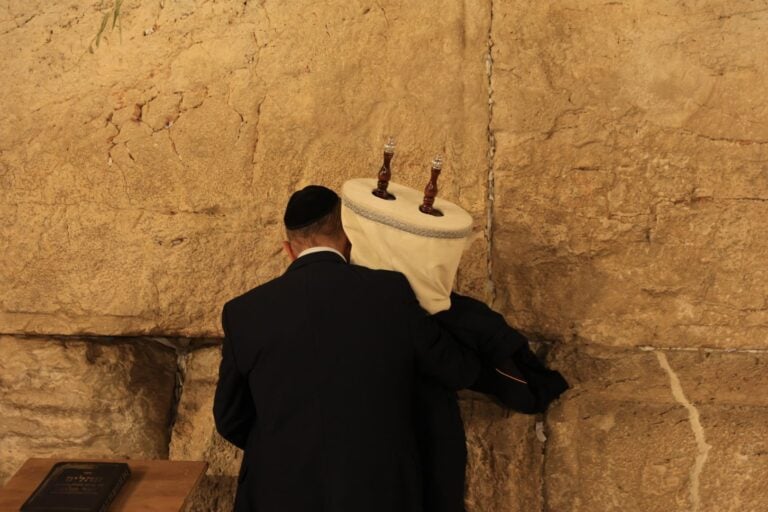
At the very beginning of the holy day, after Kol Nidrei, when the Torah scrolls are brought out of the ark and the worshippers stand facing them, we invoke the words, “and joy for the upright in heart.” At first glance, if we were asked to describe Yom Kippur, we might expect words such as awe, repentance, forgiveness, and atonement. And yet, precisely as the day begins, we awaken the emotion of joy.
This is one of the deepest dimensions of the spiritual work of Yom Kippur. We are called upon to make our hearts upright – not merely to confess what we have done, but to remove the crookedness that has taken root within us over the course of the year and return to our own true and authentic selves. When the heart becomes upright, joy does not need to come from outside. It emerges naturally from within. As Rabbi Nachman of Breslov taught: “Joy is in the heart, and one whose heart is crooked cannot rejoice.”
What is this joy of the heart, and how do we make the heart upright?
The answer lies in a person’s yearning to cleanse himself of his sins and draw close once again to his spiritual roots. It means no longer dwelling on the calculations, labels, and everything else that has distanced him from himself and from his Creator, but simply rejoicing in the privilege of being Jewish and in the extraordinary opportunity he has been given to cleanse himself of all the dirt and grime that have accumulated throughout the year and begin anew.
When a person straightens his heart and prepares himself to become a worthy vessel for receiving the holiness of the day, he experiences a simple, pure joy – a joy that reaches into the deepest chambers of the heart.
Yom Kippur gives us the opportunity to make that same inner journey: to return from crookedness to uprightness, from heaviness to freedom, and from distance to connection. And then we discover that the joy we searched for throughout the year was never far away. It was there all along, lying deep within the heart, simply waiting for us to make room for it.