Parashat Ha’azinu 5787
Rabbi Shmuel Rabinowitz, Rabbi of the Western Wall and Holy Sites
During these significant days between Rosh Hashanah and Yom Kippur, every person who desires to live seeks a way to correct the mistakes of the past year and choose the actions that will ensure a good year ahead.
Reflecting on the verses of the parasha, which is read on the Shabbat between Rosh Hashanah and Yom Kippur, reveals a profound and hopeful idea about how one can cope with failure. Moses conveys this idea in his parting words to the Jewish people, saying:
“Do you thus requite the Lord, O dull and unwise people? Is He not your Father, your Creator, He who made you and established you? Remember the days of old, consider the years of generations past; ask your father, and he will tell you; your elders, and they will inform you.”
(Deuteronomy 32:6-7)
At first, Moses expresses his astonishment at those who do not follow the path of Torah and mitzvot. After all, such behavior makes no sense: the Creator of the world is the One who created the world, who created humanity, and who gave each person the very gift of life. How, then, can a person turn his back on the One who gave him everything and repay good with evil?
Moses then offers practical advice for dealing with doubts that may lead a person away from the path of truth: Look to history. Do not think that the world began with you. Remember the days of old, reflect on the years of generations past, ask your father, and listen to your elders. A broad perspective on the chain of generations enables a person to see things in their proper perspective.
A person who follows the path and embraces the way handed down to him by his ancestors draws upon the life experience of entire generations, upon a faith that has been tested over hundreds and thousands of years, and upon a tradition that has proven itself. By contrast, someone who seeks to erase the past and create an entirely new path for himself may discover that without roots, there is also no genuine ability to ensure continuity.
In the modern era, what belongs to the previous generation is often viewed as outdated, irrelevant, and sometimes even as a burden from which one must free oneself. Yet even the great thinkers of the world recognized that later generations stand on the shoulders of those who came before them. As they put it:
“We are like dwarfs standing on the shoulders of giants, so that we can see more and farther than they did, not because of the sharpness of our own vision or the strength of our bodies, but because we are lifted and raised to a greater height by their enormous stature.”
In an age of tremendous technological progress and constant innovation, it is easy to make the mistake of viewing previous generations as uncivilized in comparison with ourselves. Yet from a Jewish perspective, the correct outlook is entirely different. The farther we move from the revelation at Mount Sinai, the more we must remember the greatness of the generations that preceded us and our responsibility to preserve the spiritual treasure they passed down from generation to generation. In the words of our Sages:
“Rabbi Zeira said in the name of Rava bar Zimuna: If the earlier generations were like angels, then we are like human beings; and if the earlier generations were like human beings, then we are like donkeys.”
(Babylonian Talmud, Shabbat 112b)
The fact that the world has advanced materially does not necessarily indicate corresponding progress on the spiritual and human levels. It is possible that modern people possess more knowledge, more advanced technology, and tools that were unavailable to their ancestors, but this does not necessarily mean that they possess greater depth or are closer to the source of truth.
This is one of the foundations behind the concept of “the decline of the generations.” The world may advance externally while, at the same time, the human being may become weaker internally. As one of the sages put it: “The more the world advances, the farther the heart retreats.” The way to preserve spiritual depth and the connection to the inner self is not by severing ties with the past, but by maintaining a connection to it. King Solomon said of this:
“My son, heed the discipline of your father, and do not forsake the teaching of your mother.”
(Proverbs 1:8)
A person who seeks to ensure stability must preserve the moral teachings of his father and the Torah of his mother. A small concession, a slight distancing, or a weakening of a particular principle can, over the course of several generations, cause everything to fade away, until nothing remains of the tradition.
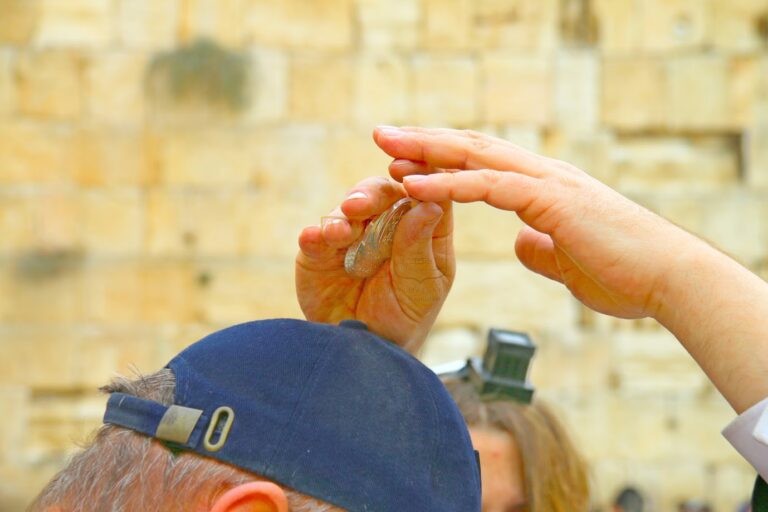
This is why it is a sacred Jewish custom for every father to bless his children with the Birkat HaBanim, the traditional parental blessing, on the eve of Yom Kippur, just before going to the synagogue for the Kol Nidrei service, only minutes before the sacred and awe-inspiring day of Yom Kippur begins. The father stands, places his hands on the heads of his children, and conveys to them a message that has been passed down from generation to generation: the surest way to merit a good and sweet year does not begin with the search for new solutions, but with relying on the foundations that have already been handed down to us. A person who learns to respect the tradition of his ancestors will find it easier to preserve the commandments of his God as well.
The answer is not merely an attempt to correct what was done during the past year. It is also a process of returning to the path on which our ancestors grew up, to the connection with Torah, with tradition, and with the Creator of the world.
A person is not required to reinvent himself. Rather, he is called upon to connect with what came before him and rediscover the path that has already been paved for him. Before we try to become something new, it is worth remembering first who we are and where we came from, and through this, to return to the Creator of the world and thereby merit being sealed for a good and sweet year.