It is interesting to note that in 1967, Dutch archeologists uncovered a temple in Deir Alla in Jordan. They found an etching on its walls that tells the story of the magician Bilam Ben Beor and quotes his prophecies of doom. Unsurprisingly, this discovery proved that the bible stories are not national myths that were fabricated in modern times, but are reliable, historic narratives.
Let us return to our story. After Bilam experienced a divine revelation instructing him not to go with Moav?s dignitaries, and not to curse Am Yisrael, he refused to go. But when another delegation came of even more respected dignitaries pleading with him to return with them to curse Am Yisrael, he experiences another revelation allowing him to go with Moav?s dignitaries while clarifying for him that he will be unable to curse the nation.
Bilam arrives at the Moav mountains and looks out onto the camp of Am Yisrael. He tries to curse the nation, but instead of curses, he finds himself uttering blessings? as he had been told he would. Bilam?s blessings/prophecies are written in lofty prose. They contain praise for Am Yisrael and prophecies about their future. But he was obviously unable to utter any curses.
Bilam tried to curse Am Yisrael three times, and three times he failed. After Balak discovered that Bilam does not have the power to curse the nation, he is deeply disappointed. With uninhibited rage, he banishes Bilam from Moav back to his home. Moments before his departure, Bilam utilizes his last chance and delivers an additional speech/prophecy.
These speeches/prophecies of Bilam?s are very interesting. Their style and content make the words with which Bilam opens his speeches seem less significant. But we should pay attention to the fourth speech which Bilam begins with the following words:
“The word of Balaam, son of Beor,
the word of a man with an open eye.
The word of the one who hears God’s sayings
and perceives the thoughts of the Most High??
(Bamidbar 24, 15-16)
We understand the essence of Bilam by the fact that he refers to himself as ?perceives the thoughts of the Most High?, meaning, he who knows what God thinks. The situation in which these words are spoken makes them particularly absurd. This man who had tried to curse Am Yisrael three times, contrary to what he had been specifically told, refers to himself as ?perceives the thoughts of the Most High?? Bilam who scarcely knows his own thoughts and cannot manage to get out the words he wants to say from his mouth and ends up saying the opposite of what he had intended to say, he claims to know God?s thoughts?!
We do not mean to make fun of Bilam, but rather to compare him with another man ? Moshe Rabeinu.
Moshe led the nation from Egypt up to the entrance to the Land of Israel; Moshe ascended to Har Sinai where he experienced a revelation in which he received the Torah. But he does not refer to himself as one who ?perceives the thoughts of the Most High?. His message is different.
In the book of Shmot, we read that Moshe appeals to God with the following:
And now, if I have indeed found favor in Your eyes, pray let me know Your ways, so that I may know You??
(Shmot 33, 13)
Moshe does not claim to know everything. He does not think that he discovered the secrets of the universe and God?s motives. Moshe admits to not being all-knowing, and from this perspective of humility, he wishes to know more.
When the bible presents us with various personalities, it wants us to learn from them. It offers us hints as to whether this is a positive personality from whom we should learn how to act or a negative one from whom we should learn how not to act. Moshe is a positive character. Why? Because he is modest. He admits that he has much to learn and know. Bilam is a negative character because his pride makes him crazy. Because he cannot admit his weakness.
ירושלים
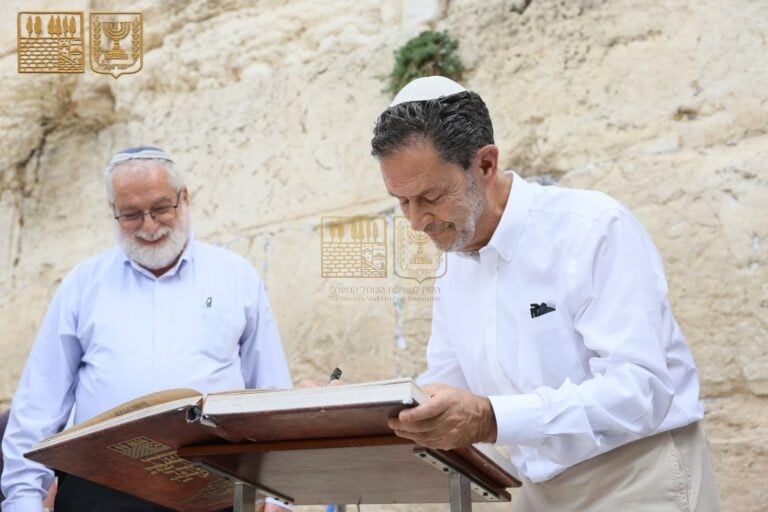
Following the Inauguration of Colombia’s Embassy in Jerusalem: Colombia’s Foreign Minister Visits the Western Wall: “This Is the Most Sublime and Profound Moment of My Life!”
As part of his official visit to Israel, and following the inauguration of Colombia’s embassy in Jerusalem, Colombian Foreign Minister Omar Bula Escobar arrived