Simchat Torah 5787
Rabbi Shmuel Rabinowitz, Rabbi of the Western Wall and Holy Sites
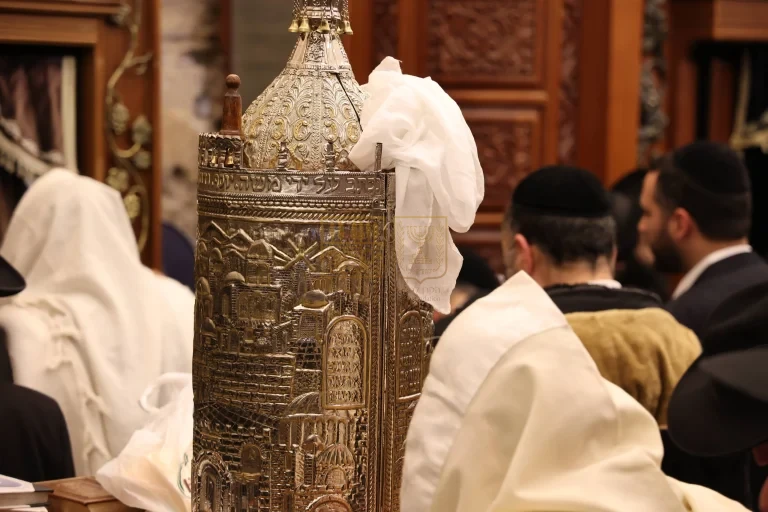
On Simchat Torah, we mark the completion of the annual cycle of Torah reading and the beginning of a new cycle. Jewish custom is to read the portion of V’Zot HaBerachah, and immediately afterward to begin reading the first portion – Bereishit – creating an unbroken continuity between the conclusion of the Torah and its beginning.
Rabbi Yaakov ben Rabbeinu Asher wrote about this:
“It is called Simchat Torah because on it we complete the Torah, and it is fitting to rejoice upon its completion. It is customary to begin Bereishit immediately, so that Satan will have no opportunity to accuse us, saying: They have already finished it and do not wish to read it again.”
(Tur, Orach Chaim, Laws of Lulav, 669)
The conclusion of the Torah and the beginning anew are not two separate things. Precisely because we finish, we hurry to begin again. Had we waited until the following Shabbat to begin reading it again, the conclusion might have appeared to be a farewell. Beginning immediately teaches us that the conclusion is not an ending in the sense of parting, but rather is meant to make possible a new beginning, with a desire to learn anew.
This idea takes on special meaning when we consider our relationship to Simchat Torah. There are people who do not feel a sense of connection to the holiday. In particular, someone who does not study Torah regularly might ask: What exactly am I so happy about? What connection do I have to dancing around the Torah scroll when, in my everyday life, I hardly ever open it?
One way to answer this is through a folk tale about a simple villager who was seen dancing with all his might with the Torah scroll, singing, “Your Torah is better for me than thousands of pieces of gold and silver.” When people asked him, “But you haven’t opened a book in a long time,” he replied: “If my brother is getting married, shouldn’t I celebrate with him?”
There is a profound point in this story. The joy of Simchat Torah is not merely an individual’s personal joy. It is joy about the Torah that exists within the people of Israel, about the connection it creates between the Jewish nation and the Creator of the world, about a Torah-centered world that continues from generation to generation, and about the people within this nation who have devoted their lives to its study. Even if I have not yet found the time and place for it in my own life, the Torah is not foreign to me. It belongs to my family, to my people, to the tradition from which I come. If my brother gets married, I rejoice in his wedding; and if the Jewish nation rejoices in the Torah, I too am part of that joy.
There is another way to understand the nature of this joy. Dancing with the Torah is not merely an expression of joy that already exists; sometimes, it is the joy itself that creates the connection. When a person dances with the Torah, he brings himself into the joy, even if at first he does not feel a deep connection to Torah study. The very effort to rejoice can open the heart and prepare a person for a new connection with the Torah.
This also has enormous educational significance. A child who sees his father rejoicing with the Torah, dancing with it and expressing his love for it, receives a message far more powerful than any explanation: the Torah is not merely a system of obligations, but something filled with life and joy. Even if the father himself has not succeeded in incorporating Torah study into his daily routine, it is very possible that the dancing the child witnesses will influence him many years later and awaken in him a desire to become a person of Torah.
And yet, we can still ask: How can someone who does not feel connected to the world of Torah relate to this joy? How can he dance enthusiastically with something he feels is not a meaningful part of his life?
In his book Pachad Yitzchak on Sukkot, Rabbi Yitzchak Hutner recounts a story about two students of the Chiddushei HaRim, the first Rebbe of Gur. The two students were dancing with tremendous enthusiasm on Simchat Torah. The Chiddushei HaRim looked at them and said to those around him: “Look at these two. One of them will tire before the other.” Indeed, a short while later, one of the students grew weak and stopped dancing, while his friend continued dancing with renewed strength.
When the Rebbe was asked how he knew this in advance, he explained:
The student who became tired was dancing out of joy over the Torah he had studied in the past. There is a limit and measure to Torah that has already been attained, and therefore his joy eventually came to an end and he became tired.
The student who did not become tired was dancing out of joy over the Torah he would study in the future. And since the future has no limit, his joy did not come to an end.
The Chiddushei HaRim added:
“The world thinks that we rejoice on Simchat Torah because we have finished the Torah. But the truth is that we rejoice because we are beginning the Torah anew.”
These words offer a new perspective on Simchat Torah: the joy is primarily about what is yet to come. Someone who studied Torah throughout the year can rejoice over what he has accomplished, but even someone who did not manage to study as much as he had hoped does not need to stand outside the circle of joy. The dancing is not a celebration of past achievements, but of the possibility of beginning again.
From this perspective, on Simchat Torah we all stand at the same starting point. One person arrives after a year in which he studied a great deal of Torah, while another barely studied at all. One arrives with great accomplishments, while another arrives with a sense of missed opportunities. But when we open the Book of Bereishit once again, both stand before the same Torah, before the same possibility, before the same year that has not yet been written.
Now we understand why, immediately after completing the Torah, we begin the Book of Bereishit anew, rather than waiting until the following Shabbat. This is the heart of the matter: we finish so that we can begin. The conclusion is not a point at which we stop and look backward, but the moment from which we set out on a new journey. In this sense, the familiar phrase “Every ending is a new beginning” takes on a particularly profound meaning on Simchat Torah.
On Simchat Torah, we do not need to ask ourselves only how much Torah we studied during the year that has passed. We can ask a different question: How much are we prepared to learn in the year that is about to begin? For Simchat Torah is not only the joy of those who have completed the Torah. It is also, and perhaps above all, the joy of those who are ready to open it anew.
Chag Sameach