But you must remember the Lord your God, for it is He that gives you strength to make wealth?
(Deuteronomy 8, 7-18)
Moses thus warns the nation of the sin of pride and haughtiness that threatens anyone successful. While they were in the desert, the nation did not face this challenge. They had no opportunity to build homes or accumulate wealth. But now as they are about to enter the Land of Israel, they may face a situation they were unaccustomed to: success and comfort may cause them to forget where they came from and who provided the ?good life? they are living. Therefore, Moses warns them and commands them to remember that the houses, the harvest, the silver, and the gold all come from God and success should not get in the way of remembering that.
But if we look closely at Moses? words, we reveal an unexpected theological complexity. Moses says, ?But you must remember the Lord your God, for it is He that gives you strength to make wealth?? He does not say ? But you must remember the Lord your God for it is He that gives you wealth.
The RaN (Rabbi Nissim of Gerona, rabbi of the Jewish community of Barcelona in the 14th century) writes about this distinction:
?It may be true that men have talents in certain areas, some being predisposed to acquiring wisdom and others to the type of thinking that leads to accumulation of wealth, so that in this respect, there is some validity to a rich man saying ?My strength and the might of my hand have accumulated this wealth for me.? Still, though this power may be implanted in you, remember who gave it to you and where it came from.?
(Drashot Haran, 10)
The moral effort to fight arrogance does not mean one should negate or demean our strengths and abilities. Man is not obligated to think that his success is not a result of his talents. Reality shows us that successful people are often those with unique gifts. If so, perhaps pride is justified. Maybe a person who succeeds in business or in politics is correct in seeing his success as a result of his talents.
Indeed, though a successful person is often a fortunate person, he is not supposed to take pride in his talents or abilities because he did not create them. Man must remember that his gifts are God-given and therefore, his financial or social successes are not his own doing but are thanks to He who gave him the ability to succeed ? namely, God!
ירושלים
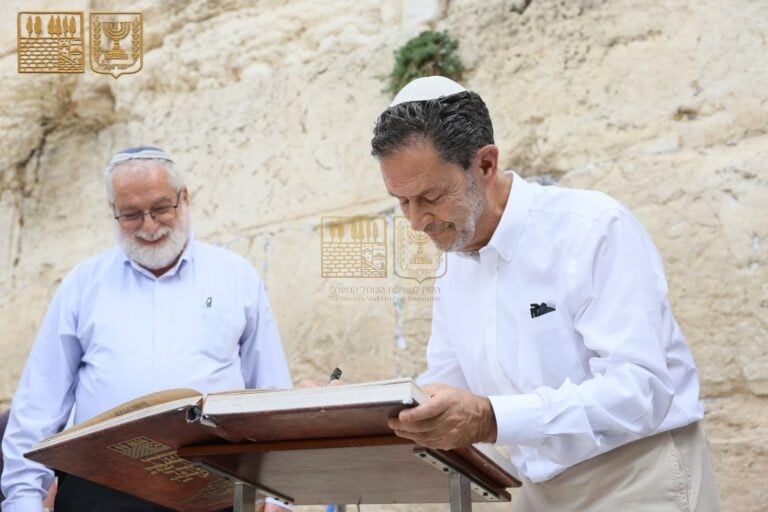
Following the Inauguration of Colombia’s Embassy in Jerusalem: Colombia’s Foreign Minister Visits the Western Wall: “This Is the Most Sublime and Profound Moment of My Life!”
As part of his official visit to Israel, and following the inauguration of Colombia’s embassy in Jerusalem, Colombian Foreign Minister Omar Bula Escobar arrived