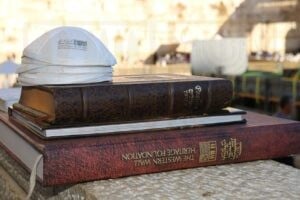
- Western Wall
- Categories
- Parasha of the Week
- Bamidbar
- Parashat Chukat
Parashat Chukat
Torah Reading Parashat Chukat
GOD
spoke to Moses and Aaron, saying:
This is the ritual law that GOD has commanded:
Instruct the Israelite people to bring you a red cow without blemish, in which there is no defect and on which no yoke has been laid.
You shall give it to Eleazar the priest. It shall be taken outside the camp and slaughtered in his presence.
Eleazar the priest shall take some of its blood with his finger and sprinkle it seven times toward the front of the Tent of Meeting.
The cow shall be burned in his sight—its hide, flesh, and blood shall be burned, its dung included—
and the priest shall take cedar wood, hyssop, and crimson stuff, and throw them into the fire consuming the cow.
The priest shall wash his garments and bathe in water; after that the priest may reenter the camp, but he shall be impure until evening.
The one who performed the burning shall also wash their garments in water, bathe, and be impure until evening.
Someone else who is pure shall gather up the ashes of the cow and deposit them outside the camp in a pure place, to be kept for water of lustrationawater of lustration Lit. “water for impurity.” for the Israelite community. It is for purgation.
The one who gathers up the ashes of the cow shall also wash their clothes and be impure until evening.
This shall be a permanent law for the Israelites and for the strangers who reside among them.
Anyone who touches the corpse of any human being shall be impure for seven days.
They shall undergo cleansing with [the ashes] on the third day and on the seventh day, and then be pure; if they fail to undergo cleansing on the third and seventh days, they shall not be pure.
Whoever touches a corpse—the body of a person who has died—and does not undergo cleansing, defiles GOD’s Tabernacle; that person shall be cut off from Israel. Since the water of lustration was not dashed on them, they remain impure; their impurity is still upon them.
This is the ritual: When a person dies in a tent, whoever enters the tent and whoever is in the tent shall be impure seven days;
and every open vessel, with no lid fastened down, shall be impure.
And in the open, anyone who touches a person who was killedbkilled Lit. “slain by the sword.” or who died naturally, or human bone, or a grave, shall be impure seven days.
Some of the ashescashes Lit. “earth” or “dust.” from the fire of purgation shall be taken for the impure person, and fresh water shall be added to them in a vessel.
Then someone who is pure shall take hyssop, dip it in the water, and sprinkle on the tent and on all the vessels and people who were there, or on the one who touched the bones or the person who was killed or died naturally or the grave.
The pure person shall sprinkle it upon the impure person on the third day and on the seventh day, thus cleansing that person by the seventh day. [The latter] shall then wash their clothes and bathe in water—and at nightfall shall be pure.
If anyone who has become impure fails to undergo cleansing, that person shall be cut off from the congregation for having defiled GOD’s sanctuary. The water of lustration was not dashed on them—they are impure.
That shall be for them a law for all time. Further, whoever sprinkled the water of lustration shall wash their clothes; and whoever touches the water of lustration shall be impure until evening.
Whatever that impure person touches shall be impure; and the person who touches [that impure one] shall be impure until evening.
The Israelites arrived in a body at the wilderness of Zin on the first new moon,afirst new moon Of the fortieth year; cf. 33.36–38. and the people stayed at Kadesh. Miriam died there and was buried there.
The community was without water, and they joined against Moses and Aaron.
The people quarreled with Moses, saying, “If only we had perished when our brothers perished by GOD’s will!bby GOD’s will Lit. “before GOD”; cf. 16.35; 17.5.
Why have you brought GOD’s congregation into this wilderness for us and our livestock to die there?
Why did you make us leave Egypt to bring us to this wretched place, a place with no grain or figs or vines or pomegranates? There is not even water to drink!”
Moses and Aaron came away from the congregation to the entrance of the Tent of Meeting, and fell on their faces. The Presence of GOD appeared to them,
and GOD spoke to Moses, saying,
“You and your brother Aaron take the rod and assemble the community, and before their very eyes order the rock to yield its water. Thus you shall produce water for them from the rock and provide drink for the congregation and their livestock.”
Moses took the rod from before GOD, as he had been commanded.
Moses and Aaron assembled the congregation in front of the rock; and he said to them, “Listen, you rebels, shall we get water for you out of this rock?”
And Moses raised his hand and struck the rock twice with his rod. Out came copious water, and the community and their livestock drank.
But GOD said to Moses and Aaron, “Because you did not trust Me enough to affirm My sanctity in the sight of the Israelite people, therefore you shall not lead this congregation into the land that I have given them.”
Those are the waters of MeribahcMeribah I.e., “Quarrel”; cf. Exod. 17.7 and the second note there.—meaning that the Israelites quarrelled with GOD—whose sanctity was affirmed through them.
From Kadesh, Moses sent messengers to the king of Edom: “Thus says your brother Israel: You know all the hardships that have befallen us;
that our ancestors went down to Egypt, that we dwelt in Egypt a long time, and that the Egyptians dealt harshly with us and our ancestors.
We cried to GOD—who, upon hearing our plea, sent a messengerda messenger I.e., Moses himself. Or “an angel.” who freed us from Egypt. Now we are in Kadesh, the town on the border of your territory.
Allow us, then, to cross your country. We will not pass through fields or vineyards, and we will not drink water from wells. We will follow the king’s highway, turning off neither to the right nor to the left until we have crossed your territory.”
But Edom answered him, “You shall not pass through us, else we will go out against you with the sword.”
“We will keep to the beaten track,” the Israelites said to them, “and if we or our cattle drink your water, we will pay for it. We ask only for passage on foot—it is but a small matter.”
But they replied, “You shall not pass through!” And Edom went out against them in heavy force, strongly armed.
So Edom would not let Israel cross their territory, and Israel turned away from them.
Setting out from Kadesh, the Israelites arrived in a body at Mount Hor.
At Mount Hor, on the boundary of the land of Edom, GOD said to Moses and Aaron,
“Let Aaron be gathered to his kin: he is not to enter the land that I have assigned to the Israelite people, because you disobeyed My command about the waters of Meribah.
Take Aaron and his son Eleazar and bring them up on Mount Hor.
Strip Aaron of his vestments and put them on his son Eleazar. There Aaron shall be gathered unto the dead.”eunto the dead Lit. “and die.”
Moses did as GOD had commanded. They ascended Mount Hor in the sight of the whole community.
Moses stripped Aaron of his vestments and put them on his son Eleazar, and Aaron died there on the summit of the mountain. When Moses and Eleazar came down from the mountain,
the whole community knew that Aaron had breathed his last. All the house of Israel bewailed Aaron thirty days.
When the Canaanite, king of Arad, who dwelt in the Negeb, learned that Israel was coming by the way of Atharim,aAtharim Meaning of Heb. ha-ʼatharim uncertain. Targum and other ancient versions render “the way [taken by] the scouts.” he engaged Israel in battle and took some of them captive.
Then Israel made a vow to GOD and said, “If You deliver this people into our hand, we will proscribebproscribe I.e., utterly destroy, reserving no booty except what is deposited in the Sanctuary; see Josh. 6.24. their towns.”
GOD heeded Israel’s plea and delivered up the Canaanites; and they and their cities were proscribed. So that place was named Hormah.cHormah Connected with heḥerim “to proscribe.”
They set out from Mount Hor by way of the Sea of ReedsdSea of Reeds Traditionally, but incorrectly, “Red Sea.” to skirt the land of Edom. But the people grew restive on the journey,
and the people spoke against God and against Moses, “Why did you make us leave Egypt to die in the wilderness? There is no bread and no water, and we have come to loathe this miserable food.”
GOD sent serapheseraph Cf. Isa. 14.29; 30.6. In contrast to others “fiery”; exact meaning of Heb. saraph uncertain. serpents against the people. They bit the people and many of the Israelites died.
The people came to Moses and said, “We sinned by speaking against GOD and against you. Intercede with GOD to take away the serpents from us!” And Moses interceded for the people.
Then GOD said to Moses, “Make a seraphfseraph See note at v. 6. figure and mount it on a standard. And anyone who was bitten who then looks at it shall recover.”
Moses made a copper serpent and mounted it on a standard; and if someone was bitten by a serpent, they would look at the copper serpent and recover.
The Israelites marched on and encamped at Oboth.
They set out from Oboth and encamped at Iye-abarim, in the wilderness bordering on Moab to the east.
From there they set out and encamped at the wadi Zered.
From there they set out and encamped beyond the Arnon, that is, in the wilderness that extends from the territory of the Amorites. For the Arnon is the boundary of Moab, between Moab and the Amorites.
Therefore the Book of the Wars of GOD speaks ofgThe quotation that follows is a fragment; its text and meaning are uncertain. “…Waheb in Suphah, and the wadis: the Arnon
with its tributary wadis, stretched along the settled country of Ar, hugging the territory of Moab…”
And from there to Beer,hBeer Lit. “well.” which is the well where GOD said to Moses, “Assemble the people that I may give them water.”
Then Israel sang this song:
Spring up, O well—sing to it—
The well that the chieftains dug,
That the nobles of the people started
With maces, with their own staffs.
And from MidbariMidbar Septuagint “the well” (= Beer); cf. v. 16. to Mattanah,
and from Mattanah to Nahaliel, and from Nahaliel to Bamoth,
and from Bamoth to the valley that is in the country of Moab, at the peak of Pisgah, overlooking the wasteland.jwasteland Or “Jeshimon.”
Israel now sent messengers to Sihon king of the Amorites, saying,
“Let me pass through your country. We will not turn off into fields or vineyards, and we will not drink water from wells. We will follow the king’s highway until we have crossed your territory.”
But Sihon would not let Israel pass through his territory. Sihon gathered all his troops and went out against Israel in the wilderness. He came to Jahaz and engaged Israel in battle.
But Israel put them to the sword, and took possession of their land, from the Arnon to the Jabbok, as far as [Az] of the Ammonites, for AzkAz Septuagint “Jazer,” cf. v. 32. marked the boundary of the Ammonites.lfor Az marked the boundary of the Ammonites In contrast to others “for the boundary of the Ammonites was strong.”
Israel took all those towns. And Israel settled in all the towns of the Amorites, in Heshbon and all its dependencies.
Now Heshbon was the city of Sihon king of the Amorites, who had fought against a former king of Moab and taken all his land from him as far as the Arnon.
Therefore the bards would recite:
mThe meaning of several parts of this ancient poem is no longer certain. “Come to Heshbon; firmly built
And well founded is Sihon’s city.
For fire went forth from Heshbon,
Flame from Sihon’s city,
Consuming Ar of Moab,
The lords of BamothnBamoth Cf. vv. 19 and 20, and 22.21. by the Arnon.
Woe to you, O Moab!
You are undone, O people of Chemosh!
His sons are rendered fugitive
And his daughters captive
By an Amorite king, Sihon.”
oMeaning of verse uncertain. Alternatively: “Their dominion is at an end / From Heshbon to Dibon / And from Nashim to Nophah, / Which is hard by Medeba.” Yet we have cast them down utterly,
Heshbon along with Dibon;
We have wrought desolation at Nophah,
Which is hard by Medeba.
So Israel occupied the land of the Amorites.
Then Moses sent to spy out Jazer, and they captured its dependencies and dispossessed the Amorites who were there.
They marched on and went up the road to Bashan, and King Og of Bashan, with all his troops, came out to Edrei to engage them in battle.
But GOD said to Moses, “Do not fear him, for I give him and all his troops and his land into your hand. You shall do to him as you did to Sihon king of the Amorites who dwelt in Heshbon.”
They defeated him and his sons and all his troops, until no remnant was left him; and they took possession of his country.
The Israelites then marched on and encamped in the steppes of Moab, across the Jordan from Jericho.
Balak son of Zippor saw all that Israel had done to the Amorites.
Moab was alarmed because that people was so numerous. Moab dreaded the Israelites,
and Moab said to the elders of Midian, “Now this horde will lick clean all that is about us as an ox licks up the grass of the field.”
Balak son of Zippor, who was king of Moab at that time,
sent messengers to Balaam son of Beor in Pethor, which is by the Euphrates,aEuphrates Lit. “the River.” in the land of his kinsfolk, to invite him, saying, “There is a people that came out of Egypt; it hides the earth from view, and it is settled next to me.
Come then, put a curse upon this people for me, since they are too numerous for me; perhaps I can thus defeat them and drive them out of the land. For I know that whomever you bless is blessed indeed, and whomever you curse is cursed.”
The elders of Moab and the elders of Midian, versed in divination,bversed in divination Lit. “with divination in their power (hand).” set out. They came to Balaam and gave him Balak’s message.
He said to them, “Spend the night here, and I shall reply to you as GOD may instruct me.” So the Moabite dignitaries stayed with Balaam.
God came to Balaam and said, “What do these men want of you?”
Balaam said to God, “Balak son of Zippor, king of Moab, sent me this message:
Here is a people that came out from Egypt and hides the earth from view. Come now and curse them for me; perhaps I can engage them in battle and drive them off.”
But God said to Balaam, “Do not go with them. You must not curse that people, for they are blessed.”
Balaam arose in the morning and said to Balak’s dignitaries, “Go back to your own country, for GOD will not let me go with you.”
The Moabite dignitaries left, and they came to Balak and said, “Balaam refused to come with us.”
Then Balak sent other dignitaries, more numerous and distinguished than the first.
They came to Balaam and said to him, “Thus says Balak son of Zippor: Please do not refuse to come to me.
I will reward you richly and I will do anything you ask of me. Only come and damn this people for me.”
Balaam replied to Balak’s officials, “Though Balak were to give me his house full of silver and gold, I could not do anything, big or little, contrary to the command of the ETERNAL my God.
So you, too, stay here overnight, and let me find out what else GOD may say to me.”
That night God came to Balaam and said to him, “If the men have come to invite you, you may go with them. But whatever I command you, that you shall do.”
When he arose in the morning, Balaam saddled his jenny and departed with the Moabite dignitaries.
But God was incensed at his going; so an angelcan angel Heb. “a messenger.” And so also through v. 35. of GOD took a position in his way as an adversary.
He was riding on his jenny, with his two servants alongside,
when the jenny caught sight of the angel of GOD standing in the way, with his drawn sword in his hand. The jenny swerved from the road and went into the fields; and Balaam beat the jenny to turn her back onto the road.
The angel of GOD then stationed himself in a lane between the vineyards, with a fence on either side.
The jenny, seeing the angel of GOD, pressed herself against the wall and squeezed Balaam’s foot against the wall; so he beat her again.
Once more the angel of GOD moved forward and stationed himself on a spot so narrow that there was no room to swerve right or left.
When the jenny now saw the angel of GOD, she lay down under Balaam; and Balaam was furious and beat the jenny with his stick.
Then GOD opened the jenny’s mouth, and she said to Balaam, “What have I done to you that you have beaten me these three times?”
Balaam said to the jenny, “You have made a mockery of me! If I had a sword with me, I’d kill you.”
The jenny said to Balaam, “Look, I am the jenny that you have been riding all along until this day! Have I been in the habit of doing thus to you?” And he answered, “No.”
Then GOD uncovered Balaam’s eyes, and he saw the angel of GOD standing in the way, his drawn sword in his hand; thereupon he bowed right down to the ground.dright down to the ground Lit. “and prostrated himself to his nostrils.”
The angel of GOD said to him, “Why have you beaten your jenny these three times? It is I who came out as an adversary, for the errand is obnoxiouseobnoxious Precise meaning of Heb. yaraṭ uncertain. to me.
And when the jenny saw me, she shied away because of me those three times. If she had not shied away from me, you are the one I should have killed, while sparing her.”
Balaam said to the angel of GOD, “I erred because I did not know that you were standing in my way. If you still disapprove, I will turn back.”
But the angel of GOD said to Balaam, “Go with the men. But you must say nothing except what I tell you.” So Balaam went on with Balak’s dignitaries.
When Balak heard that Balaam was coming, he went out to meet him at Ir-moab, which is on the Arnon border, at its farthest point.
Balak said to Balaam, “When I first sent to invite you, why didn’t you come to me? Am I really unable to reward you?”
But Balaam said to Balak, “And now that I have come to you, have I the power to speak freely? I can utter only the word that God puts into my mouth.”
Balaam went with Balak and they came to Kiriath-huzoth.
Balak sacrificed oxen and sheep, and had them served to Balaam and the dignitaries with him.
In the morning Balak took Balaam up to Bamoth-baal. From there he could see a portion of the people.
This is the ritual law that GOD has commanded:
Instruct the Israelite people to bring you a red cow without blemish, in which there is no defect and on which no yoke has been laid.
You shall give it to Eleazar the priest. It shall be taken outside the camp and slaughtered in his presence.
Eleazar the priest shall take some of its blood with his finger and sprinkle it seven times toward the front of the Tent of Meeting.
The cow shall be burned in his sight—its hide, flesh, and blood shall be burned, its dung included—
and the priest shall take cedar wood, hyssop, and crimson stuff, and throw them into the fire consuming the cow.
The priest shall wash his garments and bathe in water; after that the priest may reenter the camp, but he shall be impure until evening.
The one who performed the burning shall also wash their garments in water, bathe, and be impure until evening.
Someone else who is pure shall gather up the ashes of the cow and deposit them outside the camp in a pure place, to be kept for water of lustrationawater of lustration Lit. “water for impurity.” for the Israelite community. It is for purgation.
The one who gathers up the ashes of the cow shall also wash their clothes and be impure until evening.
This shall be a permanent law for the Israelites and for the strangers who reside among them.
Anyone who touches the corpse of any human being shall be impure for seven days.
They shall undergo cleansing with [the ashes] on the third day and on the seventh day, and then be pure; if they fail to undergo cleansing on the third and seventh days, they shall not be pure.
Whoever touches a corpse—the body of a person who has died—and does not undergo cleansing, defiles GOD’s Tabernacle; that person shall be cut off from Israel. Since the water of lustration was not dashed on them, they remain impure; their impurity is still upon them.
This is the ritual: When a person dies in a tent, whoever enters the tent and whoever is in the tent shall be impure seven days;
and every open vessel, with no lid fastened down, shall be impure.
And in the open, anyone who touches a person who was killedbkilled Lit. “slain by the sword.” or who died naturally, or human bone, or a grave, shall be impure seven days.
Some of the ashescashes Lit. “earth” or “dust.” from the fire of purgation shall be taken for the impure person, and fresh water shall be added to them in a vessel.
Then someone who is pure shall take hyssop, dip it in the water, and sprinkle on the tent and on all the vessels and people who were there, or on the one who touched the bones or the person who was killed or died naturally or the grave.
The pure person shall sprinkle it upon the impure person on the third day and on the seventh day, thus cleansing that person by the seventh day. [The latter] shall then wash their clothes and bathe in water—and at nightfall shall be pure.
If anyone who has become impure fails to undergo cleansing, that person shall be cut off from the congregation for having defiled GOD’s sanctuary. The water of lustration was not dashed on them—they are impure.
That shall be for them a law for all time. Further, whoever sprinkled the water of lustration shall wash their clothes; and whoever touches the water of lustration shall be impure until evening.
Whatever that impure person touches shall be impure; and the person who touches [that impure one] shall be impure until evening.
The Israelites arrived in a body at the wilderness of Zin on the first new moon,afirst new moon Of the fortieth year; cf. 33.36–38. and the people stayed at Kadesh. Miriam died there and was buried there.
The community was without water, and they joined against Moses and Aaron.
The people quarreled with Moses, saying, “If only we had perished when our brothers perished by GOD’s will!bby GOD’s will Lit. “before GOD”; cf. 16.35; 17.5.
Why have you brought GOD’s congregation into this wilderness for us and our livestock to die there?
Why did you make us leave Egypt to bring us to this wretched place, a place with no grain or figs or vines or pomegranates? There is not even water to drink!”
Moses and Aaron came away from the congregation to the entrance of the Tent of Meeting, and fell on their faces. The Presence of GOD appeared to them,
and GOD spoke to Moses, saying,
“You and your brother Aaron take the rod and assemble the community, and before their very eyes order the rock to yield its water. Thus you shall produce water for them from the rock and provide drink for the congregation and their livestock.”
Moses took the rod from before GOD, as he had been commanded.
Moses and Aaron assembled the congregation in front of the rock; and he said to them, “Listen, you rebels, shall we get water for you out of this rock?”
And Moses raised his hand and struck the rock twice with his rod. Out came copious water, and the community and their livestock drank.
But GOD said to Moses and Aaron, “Because you did not trust Me enough to affirm My sanctity in the sight of the Israelite people, therefore you shall not lead this congregation into the land that I have given them.”
Those are the waters of MeribahcMeribah I.e., “Quarrel”; cf. Exod. 17.7 and the second note there.—meaning that the Israelites quarrelled with GOD—whose sanctity was affirmed through them.
From Kadesh, Moses sent messengers to the king of Edom: “Thus says your brother Israel: You know all the hardships that have befallen us;
that our ancestors went down to Egypt, that we dwelt in Egypt a long time, and that the Egyptians dealt harshly with us and our ancestors.
We cried to GOD—who, upon hearing our plea, sent a messengerda messenger I.e., Moses himself. Or “an angel.” who freed us from Egypt. Now we are in Kadesh, the town on the border of your territory.
Allow us, then, to cross your country. We will not pass through fields or vineyards, and we will not drink water from wells. We will follow the king’s highway, turning off neither to the right nor to the left until we have crossed your territory.”
But Edom answered him, “You shall not pass through us, else we will go out against you with the sword.”
“We will keep to the beaten track,” the Israelites said to them, “and if we or our cattle drink your water, we will pay for it. We ask only for passage on foot—it is but a small matter.”
But they replied, “You shall not pass through!” And Edom went out against them in heavy force, strongly armed.
So Edom would not let Israel cross their territory, and Israel turned away from them.
Setting out from Kadesh, the Israelites arrived in a body at Mount Hor.
At Mount Hor, on the boundary of the land of Edom, GOD said to Moses and Aaron,
“Let Aaron be gathered to his kin: he is not to enter the land that I have assigned to the Israelite people, because you disobeyed My command about the waters of Meribah.
Take Aaron and his son Eleazar and bring them up on Mount Hor.
Strip Aaron of his vestments and put them on his son Eleazar. There Aaron shall be gathered unto the dead.”eunto the dead Lit. “and die.”
Moses did as GOD had commanded. They ascended Mount Hor in the sight of the whole community.
Moses stripped Aaron of his vestments and put them on his son Eleazar, and Aaron died there on the summit of the mountain. When Moses and Eleazar came down from the mountain,
the whole community knew that Aaron had breathed his last. All the house of Israel bewailed Aaron thirty days.
When the Canaanite, king of Arad, who dwelt in the Negeb, learned that Israel was coming by the way of Atharim,aAtharim Meaning of Heb. ha-ʼatharim uncertain. Targum and other ancient versions render “the way [taken by] the scouts.” he engaged Israel in battle and took some of them captive.
Then Israel made a vow to GOD and said, “If You deliver this people into our hand, we will proscribebproscribe I.e., utterly destroy, reserving no booty except what is deposited in the Sanctuary; see Josh. 6.24. their towns.”
GOD heeded Israel’s plea and delivered up the Canaanites; and they and their cities were proscribed. So that place was named Hormah.cHormah Connected with heḥerim “to proscribe.”
They set out from Mount Hor by way of the Sea of ReedsdSea of Reeds Traditionally, but incorrectly, “Red Sea.” to skirt the land of Edom. But the people grew restive on the journey,
and the people spoke against God and against Moses, “Why did you make us leave Egypt to die in the wilderness? There is no bread and no water, and we have come to loathe this miserable food.”
GOD sent serapheseraph Cf. Isa. 14.29; 30.6. In contrast to others “fiery”; exact meaning of Heb. saraph uncertain. serpents against the people. They bit the people and many of the Israelites died.
The people came to Moses and said, “We sinned by speaking against GOD and against you. Intercede with GOD to take away the serpents from us!” And Moses interceded for the people.
Then GOD said to Moses, “Make a seraphfseraph See note at v. 6. figure and mount it on a standard. And anyone who was bitten who then looks at it shall recover.”
Moses made a copper serpent and mounted it on a standard; and if someone was bitten by a serpent, they would look at the copper serpent and recover.
The Israelites marched on and encamped at Oboth.
They set out from Oboth and encamped at Iye-abarim, in the wilderness bordering on Moab to the east.
From there they set out and encamped at the wadi Zered.
From there they set out and encamped beyond the Arnon, that is, in the wilderness that extends from the territory of the Amorites. For the Arnon is the boundary of Moab, between Moab and the Amorites.
Therefore the Book of the Wars of GOD speaks ofgThe quotation that follows is a fragment; its text and meaning are uncertain. “…Waheb in Suphah, and the wadis: the Arnon
with its tributary wadis, stretched along the settled country of Ar, hugging the territory of Moab…”
And from there to Beer,hBeer Lit. “well.” which is the well where GOD said to Moses, “Assemble the people that I may give them water.”
Then Israel sang this song:
Spring up, O well—sing to it—
The well that the chieftains dug,
That the nobles of the people started
With maces, with their own staffs.
And from MidbariMidbar Septuagint “the well” (= Beer); cf. v. 16. to Mattanah,
and from Mattanah to Nahaliel, and from Nahaliel to Bamoth,
and from Bamoth to the valley that is in the country of Moab, at the peak of Pisgah, overlooking the wasteland.jwasteland Or “Jeshimon.”
Israel now sent messengers to Sihon king of the Amorites, saying,
“Let me pass through your country. We will not turn off into fields or vineyards, and we will not drink water from wells. We will follow the king’s highway until we have crossed your territory.”
But Sihon would not let Israel pass through his territory. Sihon gathered all his troops and went out against Israel in the wilderness. He came to Jahaz and engaged Israel in battle.
But Israel put them to the sword, and took possession of their land, from the Arnon to the Jabbok, as far as [Az] of the Ammonites, for AzkAz Septuagint “Jazer,” cf. v. 32. marked the boundary of the Ammonites.lfor Az marked the boundary of the Ammonites In contrast to others “for the boundary of the Ammonites was strong.”
Israel took all those towns. And Israel settled in all the towns of the Amorites, in Heshbon and all its dependencies.
Now Heshbon was the city of Sihon king of the Amorites, who had fought against a former king of Moab and taken all his land from him as far as the Arnon.
Therefore the bards would recite:
mThe meaning of several parts of this ancient poem is no longer certain. “Come to Heshbon; firmly built
And well founded is Sihon’s city.
For fire went forth from Heshbon,
Flame from Sihon’s city,
Consuming Ar of Moab,
The lords of BamothnBamoth Cf. vv. 19 and 20, and 22.21. by the Arnon.
Woe to you, O Moab!
You are undone, O people of Chemosh!
His sons are rendered fugitive
And his daughters captive
By an Amorite king, Sihon.”
oMeaning of verse uncertain. Alternatively: “Their dominion is at an end / From Heshbon to Dibon / And from Nashim to Nophah, / Which is hard by Medeba.” Yet we have cast them down utterly,
Heshbon along with Dibon;
We have wrought desolation at Nophah,
Which is hard by Medeba.
So Israel occupied the land of the Amorites.
Then Moses sent to spy out Jazer, and they captured its dependencies and dispossessed the Amorites who were there.
They marched on and went up the road to Bashan, and King Og of Bashan, with all his troops, came out to Edrei to engage them in battle.
But GOD said to Moses, “Do not fear him, for I give him and all his troops and his land into your hand. You shall do to him as you did to Sihon king of the Amorites who dwelt in Heshbon.”
They defeated him and his sons and all his troops, until no remnant was left him; and they took possession of his country.
The Israelites then marched on and encamped in the steppes of Moab, across the Jordan from Jericho.
Balak son of Zippor saw all that Israel had done to the Amorites.
Moab was alarmed because that people was so numerous. Moab dreaded the Israelites,
and Moab said to the elders of Midian, “Now this horde will lick clean all that is about us as an ox licks up the grass of the field.”
Balak son of Zippor, who was king of Moab at that time,
sent messengers to Balaam son of Beor in Pethor, which is by the Euphrates,aEuphrates Lit. “the River.” in the land of his kinsfolk, to invite him, saying, “There is a people that came out of Egypt; it hides the earth from view, and it is settled next to me.
Come then, put a curse upon this people for me, since they are too numerous for me; perhaps I can thus defeat them and drive them out of the land. For I know that whomever you bless is blessed indeed, and whomever you curse is cursed.”
The elders of Moab and the elders of Midian, versed in divination,bversed in divination Lit. “with divination in their power (hand).” set out. They came to Balaam and gave him Balak’s message.
He said to them, “Spend the night here, and I shall reply to you as GOD may instruct me.” So the Moabite dignitaries stayed with Balaam.
God came to Balaam and said, “What do these men want of you?”
Balaam said to God, “Balak son of Zippor, king of Moab, sent me this message:
Here is a people that came out from Egypt and hides the earth from view. Come now and curse them for me; perhaps I can engage them in battle and drive them off.”
But God said to Balaam, “Do not go with them. You must not curse that people, for they are blessed.”
Balaam arose in the morning and said to Balak’s dignitaries, “Go back to your own country, for GOD will not let me go with you.”
The Moabite dignitaries left, and they came to Balak and said, “Balaam refused to come with us.”
Then Balak sent other dignitaries, more numerous and distinguished than the first.
They came to Balaam and said to him, “Thus says Balak son of Zippor: Please do not refuse to come to me.
I will reward you richly and I will do anything you ask of me. Only come and damn this people for me.”
Balaam replied to Balak’s officials, “Though Balak were to give me his house full of silver and gold, I could not do anything, big or little, contrary to the command of the ETERNAL my God.
So you, too, stay here overnight, and let me find out what else GOD may say to me.”
That night God came to Balaam and said to him, “If the men have come to invite you, you may go with them. But whatever I command you, that you shall do.”
When he arose in the morning, Balaam saddled his jenny and departed with the Moabite dignitaries.
But God was incensed at his going; so an angelcan angel Heb. “a messenger.” And so also through v. 35. of GOD took a position in his way as an adversary.
He was riding on his jenny, with his two servants alongside,
when the jenny caught sight of the angel of GOD standing in the way, with his drawn sword in his hand. The jenny swerved from the road and went into the fields; and Balaam beat the jenny to turn her back onto the road.
The angel of GOD then stationed himself in a lane between the vineyards, with a fence on either side.
The jenny, seeing the angel of GOD, pressed herself against the wall and squeezed Balaam’s foot against the wall; so he beat her again.
Once more the angel of GOD moved forward and stationed himself on a spot so narrow that there was no room to swerve right or left.
When the jenny now saw the angel of GOD, she lay down under Balaam; and Balaam was furious and beat the jenny with his stick.
Then GOD opened the jenny’s mouth, and she said to Balaam, “What have I done to you that you have beaten me these three times?”
Balaam said to the jenny, “You have made a mockery of me! If I had a sword with me, I’d kill you.”
The jenny said to Balaam, “Look, I am the jenny that you have been riding all along until this day! Have I been in the habit of doing thus to you?” And he answered, “No.”
Then GOD uncovered Balaam’s eyes, and he saw the angel of GOD standing in the way, his drawn sword in his hand; thereupon he bowed right down to the ground.dright down to the ground Lit. “and prostrated himself to his nostrils.”
The angel of GOD said to him, “Why have you beaten your jenny these three times? It is I who came out as an adversary, for the errand is obnoxiouseobnoxious Precise meaning of Heb. yaraṭ uncertain. to me.
And when the jenny saw me, she shied away because of me those three times. If she had not shied away from me, you are the one I should have killed, while sparing her.”
Balaam said to the angel of GOD, “I erred because I did not know that you were standing in my way. If you still disapprove, I will turn back.”
But the angel of GOD said to Balaam, “Go with the men. But you must say nothing except what I tell you.” So Balaam went on with Balak’s dignitaries.
When Balak heard that Balaam was coming, he went out to meet him at Ir-moab, which is on the Arnon border, at its farthest point.
Balak said to Balaam, “When I first sent to invite you, why didn’t you come to me? Am I really unable to reward you?”
But Balaam said to Balak, “And now that I have come to you, have I the power to speak freely? I can utter only the word that God puts into my mouth.”
Balaam went with Balak and they came to Kiriath-huzoth.
Balak sacrificed oxen and sheep, and had them served to Balaam and the dignitaries with him.
In the morning Balak took Balaam up to Bamoth-baal. From there he could see a portion of the people.

Parashat Chukat
Rabbi Shmuel Rabinowitz, Rabbi of the Western Wall and Holy Sites
This week’s Torah portion of Chukat tells us one of the commandments that
Rabbi Shmuel Rabinowitz, Rabbi of the Western Wall and Holy Sites
This week’s Torah portion of Chukat tells us one of the commandments that
All articles loaded
No more articles to load
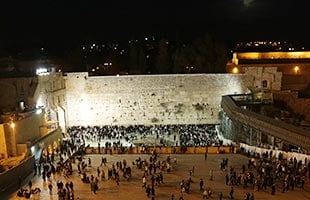
Today May 14, 2026
Dawn:
End of prayer time:
Mid day:
Sunset:
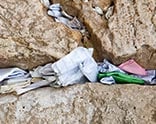
Send a Note
Western Wall Cameras
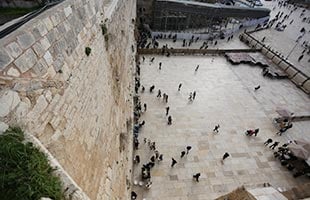
Watch the Western Wall in real-time
Interesting Facts
The Western Wall's visible stones tell of its history from the time of the Holy Temples' ruin. The original Herodian stones are distinct from the others in size and in their unique borders.
The building style of "grading" used when layering the Western Wall's stones, teaches us that the Temple Mount's walls were not perpendicular but marginally sloping.