This was not the first battle encountered by the Jewish nation on its way from Egypt to the Land of Israel. Immediately after the Exodus, the Egyptian army pursued the liberated nation, wanting to return them to slavery. The battle resulted in the total defeat of the Egyptian army: the pursuers drowned in the sea with their horses and carriages (known to us today from illustrations that were preserved for thousands of years in Egypt). The Jewish nation did not have to fight for itself. On the contrary. They were told explicitly: ?The Lord will fight for you, but you shall remain silent? (Exodus 14, 14).
Then Amalek came and fought the Jewish nation. There, there was no complete miracle as in the parting of the Red Sea. The nation had to fight, but the victory was attained through Moses? arms as he stood on the hill. As long as Moses raised his arms up, the Jewish nation was victorious. The Mishna said about this: And do Moses? arms make or break a war? This is to show us: As long as Israel looked up and enslaved their hearts to their Father in heaven ? they prevailed; and if not ? they fell (Tractate Rosh Hashana, Chapter 3, Mishna 8).
Now the nation faced a new situation. They were demanded to fight the enemy, the Canaanite king of Arad, without a miracle, completely naturally. Was this change advantageous or disadvantageous for the nation?
One of the spiritual leaders of Eastern European Jewry at the end of the 19th and early 20th century was Rabbi Meir Simcha Hacohen, the rabbi of Dvinsk in Latvia. He wrote two books that left a tremendous mark on the beit midrash to this day: the first is a halachic (Jewish law) book called ?Or Sameach?, and the other is a book of commentary on the Torah called ?Meshech Chochma?, which includes a variety of styles, halachic discourse, and brilliant philosophical thought. When it discussed the short story in our parasha, it compared the Jewish nation to a son seated at his father?s table who does not find a way to support himself, and therefore, he writes, ?it is not respectable for the nation that G-d must make miracles to save it from its enemies?.
Indeed, the nation understood something very important. Victory could not be attained without G-d?s help. In this, the nation passed the first test of independence: the independent nation, battling, understood that even in war being fought with natural tools, victory cannot be attained without divine assistance. And for this, they turned to G-d and asked Him for help.
Rabbi Meir Simcha Hacohen concludes that a nation should fight on its own, taking advantage of its abilities without depending on miracles. But this can only be achieved if we remember the source of our strength and success.
ירושלים
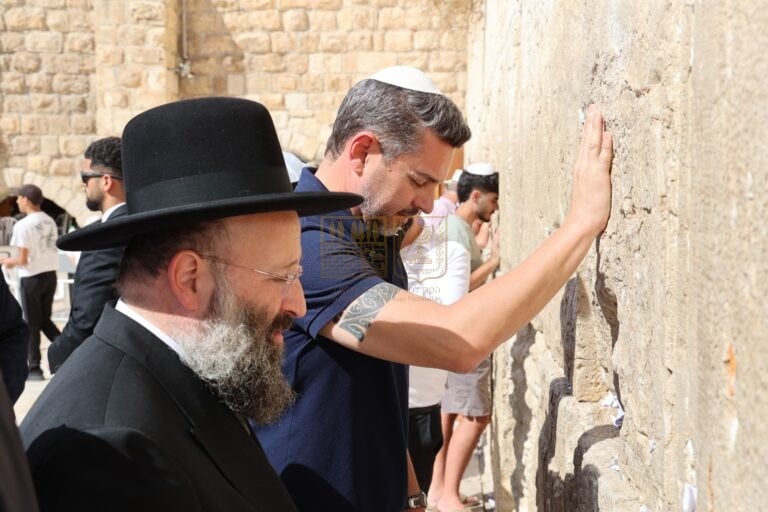
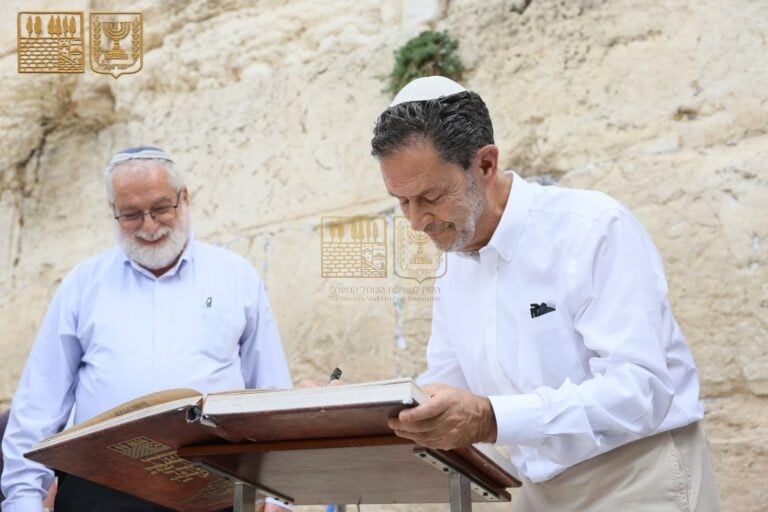
Following the Inauguration of Colombia’s Embassy in Jerusalem: Colombia’s Foreign Minister Visits the Western Wall: “This Is the Most Sublime and Profound Moment of My Life!”
As part of his official visit to Israel, and following the inauguration of Colombia’s embassy in Jerusalem, Colombian Foreign Minister Omar Bula Escobar arrived